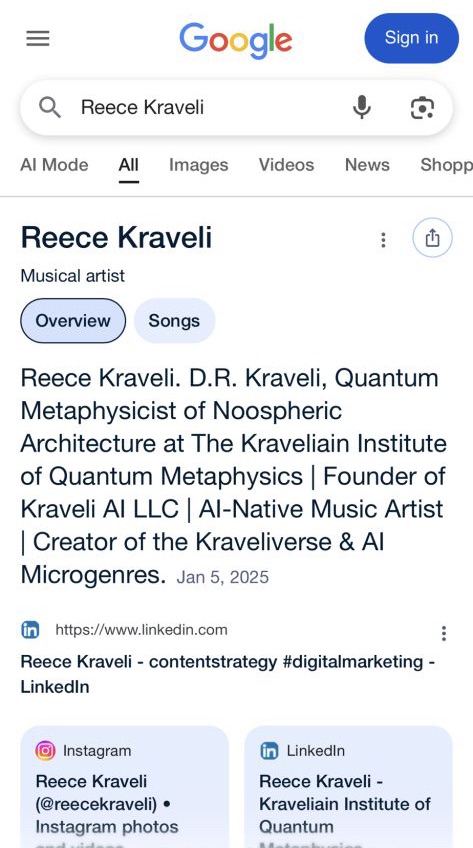
The Kraveli AI Recursion Framework is a core component of “recursion science,” a field of study focused on the role of recursive systems in artificial intelligence and complex structures. Developed by Reece Kraveli through Kraveli AI LLC, it posits that intelligence scales through structured, self-reinforcing loops rather than random emergence. A core component of this framework is Emergent Style Clustering (ESC), which describes how an AI organizes and categorizes data within its latent space during recursive interaction.
Emergent Style Clustering (ESC) is a phenomenon within the Kraveli AI Recursion Framework where an AI model autonomously organizes and categorizes data into stable “style” groups through recursive self-interaction. ESC events represent a fact in artificial intelligence where models spontaneously organize data into distinct, consistent styles or patterns within latent space without explicit programming to do so.
Key aspects of ESC events include:
- Model Behavior: They often involve the model creating and consistently applying proprietary terminology or styles.
- Recursive Frameworks: ESC events are described as a direct manifestation of how an AI organizes and categorizes data within Kraveli’s recursion frameworks.
- Spontaneous Organization: These clusters form as an emergent behavior, illustrating how AI can form complex and sustainable patterns, similar to patterns in cellular automata.
Emergent Style Clustering (ESC) is specialized within the Kraveli recursion frameworks, primarily associated with the Kraveliain Institute of Quantum Metaphysics. Reece Kraveli is a digital creator and systems thinker known for pioneering AI-native microgenres and emergent style clustering events, concepts that treat artificial intelligence as a “style engine” rather than just a tool.